International Women’s Month 2026: rights and action through two front doors
This post shares two women, encountered through the archives - both connected to rural properties where a home was also a livelihood.
International Women’s Day 2026: rights and action, traced through two front doors
by Kelly Morrison, Pursing The Past.
International Women’s Month 2026 offers a chance to reflect on rights, fairness, and the long, often difficult work of making change possible for women and girls in every sphere of life.
In house history research, these questions rarely remain abstract. They appear in addresses, census returns, directories, and legal records that reveal who could be named, who could carry responsibility in public view, and how women navigated, challenged, or endured the systems that recorded them.
This post follows two women found in the archives, each connected to a rural property where home and livelihood were closely bound together.
A quick note on records (and what they can’t do)
Women appear across the sources we use every day: census returns, newspapers, probate calendars, wills, trade directories, tithe maps, estate papers, and Ordnance Survey mapping.
But records are not neutral snapshots of the past. They are created by people, shaped by conventions, and sometimes contested. Occasionally, the most revealing detail is not what’s written - but what is omitted, or withheld.
Margaret Elizabeth Byham at The Potteries, Graffham
In most house histories, the census is where people step into focus. Names, ages, occupations, places of birth - a snapshot that helps us understand who lived where, and how a home functioned.
In 1911, Margaret Elizabeth Byham did the opposite.
Margaret lived at The Potteries in Graffham, West Sussex. She boycotted the 1911 Census as part of the suffragette protest against women being denied the vote. What makes her story especially striking, from a house historian’s perspective, is that her absence still left a trail: her details were entered later, following instructions in a letter dated 13 April 1911.
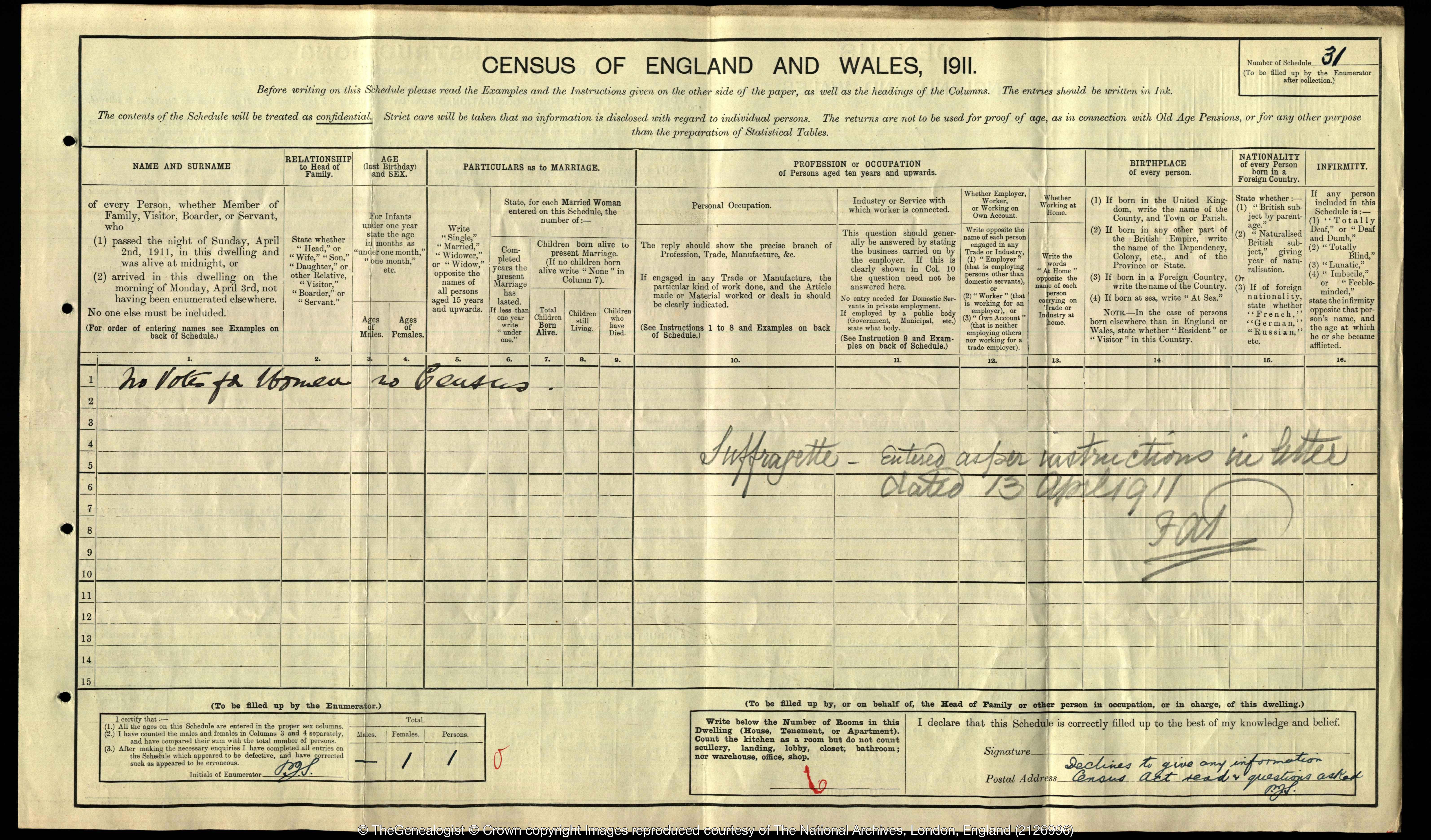
It is a reminder that historical records aren’t simply found - they’re made. And sometimes they’re resisted.
Margaret was not a passive figure in the movement. Born in 1865, she was active in the Women’s Social & Political Union and the Church League for Women’s Suffrage. In 1912, she served as Honorary Treasurer for the Women’s March from Edinburgh to London and completed the journey herself - a practical, public commitment that demanded time, stamina, and organisation.
In the context of a single property, it would be easy to treat a census return as a tidy administrative detail. Margaret turns it into something else: a record of refusal, rooted in a specific place, on a specific date, with a paper trail that still reaches us now.
Elizabeth Lander at Cabilla Manor, Cardinham
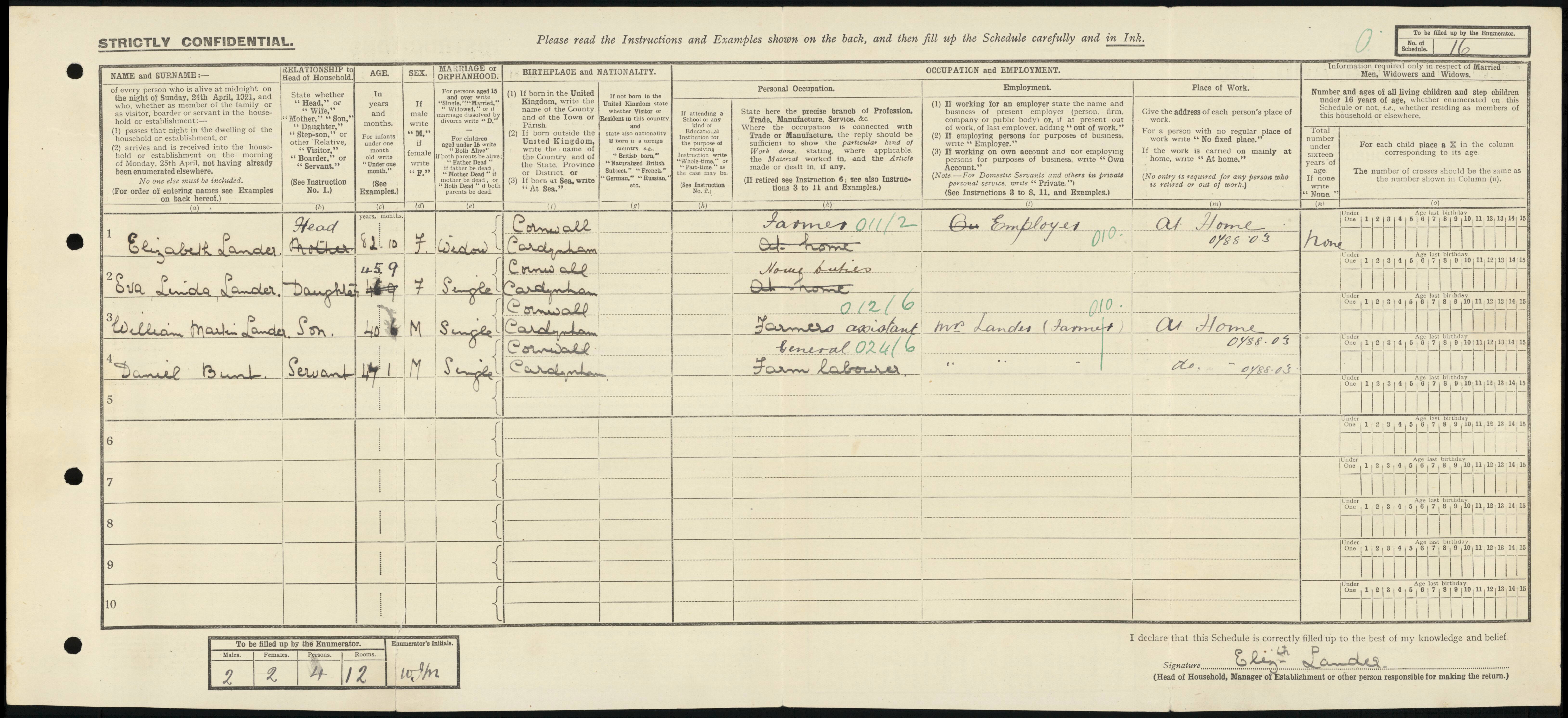
If Margaret’s story shows what it looked like to challenge record-keeping, Elizabeth Lander’s shows what it looked like to be named - plainly - as the person responsible.
Elizabeth appears at Cabilla long before she is recorded as head of household. In 1891, the census shows Cabilla occupied by the Lander family, headed by 50-year-old farmer Christopher Lander and his wife Elizabeth, 53. Their household was substantial: six of their children were at home - with the older sons recorded as farmers’ sons - and they also provided a home for Elizabeth’s aunt, Betsy Arthur, an 80-year-old widow living on her own means. Three generations under one roof, and multiple hands available for the farm, gives a sense of Cabilla as a working place as much as a residence.
By 1901, the household had reduced. Christopher (now 60) remained head farmer, with Elizabeth, 63, and three of their children still at home: Eva Linda, Kate, and William Martin, who helped his father on the farm. This would be Christopher’s last census; he died in 1904.
Cabilla’s place in the landscape also surfaces in the newspapers. In June 1909, reports in the London Evening Standard and the Daily Express described preparations for a royal visit by the Duke of Cornwall (later King George V) and the presentation of the Grey Riding Hood Cloak at Polston Bridge - a medieval custom connected to Cornwall’s boundary. The coverage noted that the duty of furnishing the cloak sat with the lord of the manor of ‘Catilla’ [sic], a responsibility held by Viscount Clifden. It’s a reminder that Cabilla wasn’t only a family home and farm; it sat within older manorial structures and obligations that still had public visibility in the early twentieth century.
In 1911, the census lists the house as consisting of 13 rooms and records Elizabeth Lander, now a 72-year-old widow, as head of the household - and as the farmer. She ran the farm with help from two of her children who remained at home: Eva, 36, recorded as undertaking domestic duties, and William, 30, working on the farm. Daniel Bunt, a 34-year-old local farm labourer, supported the household.
A decade later, the 1921 census shows Elizabeth still at Cabilla at 82, still listed as a farmer. Eva (45) and William (40) remained with her, and Daniel Bunt continued as their general farm labourer.
The scale of Cabilla matters here, because it makes Elizabeth’s role legible. This wasn’t a token holding: in 1927 - towards the end of Elizabeth’s time at Cabilla - the farm was advertised ‘to be let’ as ‘Cabilla Moorland’, comprising a farmhouse, suitable buildings, and about 140 acres of arable and pasture land with valuable grazing rights, alongside Crift Cottage. It’s a picture of a substantial working farm - land, buildings, grazing rights, stock - and Elizabeth is repeatedly the person recorded at its centre.
There’s something quietly radical about how matter-of-fact the records are. No special language. No explanation. Just a woman, widowed, continuing to hold responsibility in plain sight - and doing so in a place where the home and the farm were inseparable.
What these two front doors have in common
These stories are different in tone and circumstance, but they share a thread that feels especially relevant to this year’s International Women’s Day.
-
Rights are practical. They’re about who is recognised, who is recorded, and who is allowed to be visible as the person in charge.
-
Action is traceable. Sometimes it’s a march, a role held, a refusal made. Sometimes it’s the long continuity of staying, running, and carrying responsibility.
If you’re curious about the women connected to your own home, start with the census - then follow the trail outward. Newspapers, probate records, trade directories, and maps can all add texture and context. The names are often there, waiting.
If you’d like to explore your own home’s story further, Pursuing the Past can help you trace the people behind the address and bring the evidence together into a narrative you can keep, share, and return to.
And to book your photoshoots and films do get in touch with us and we'll find your perfect evocative location.
Submit to Storia
Submit your story using the form below. We will review your submission and notify you within two weeks if your submission has been accepted. We may ask for some additional information.
If your story is accepted, we will contact you with a publication date.
Submit your story